Are Running Out of Cash?
How many months of cash are you really sitting on , and could you pay more than one month of expenses if your income dropped tomorrow?
It’s a question most business owners avoid. Do you really know how many months your business could survive if revenue suddenly stopped? For most business owners, not sure.
In my experience crunching numbers for law firms, the core problem is that a "profitable" P&L is the only guide. But it’s a lie if you don't have enough cash in the bank.
What is the point of leaving your cash (debtors) in other people’s bank accounts for 18 to 24 months. Is that your play, paying tax on money you have not collected?
You can be profitable on paper but still run out of money. You’re neglecting the one metric that matters in a downturn: your Cash Runway. That’s the number of months you can cover your operating expenses with your current cash reserves.
Think about it. You’re technically profitable, yet you feel that constant, low-level dread. A big client is 60 days late on an invoice. You have to make payroll next week. Suddenly, the entire business feels brittle. You realize one small, unexpected shock, a dip in sales, a major equipment failure could bring everything crashing down. You’re not running a sustainable business, you're running on hope and luck.
I remember being asked on a daily basis, how much have we collected?
You feel trapped, constantly focused on chasing the next bit of revenue just to keep the engine ticking over. There's a knot in your stomach because you know the business is too exposed, and you feel responsible for everyone who relies on it. While the high-growth founders next to you are making strategic bets, you're just praying to make it to the end of the quarter.
This is why you need to stop chasing revenue as the only solution and immediately focus on the most effective cash injection, cutting wasteful costs.
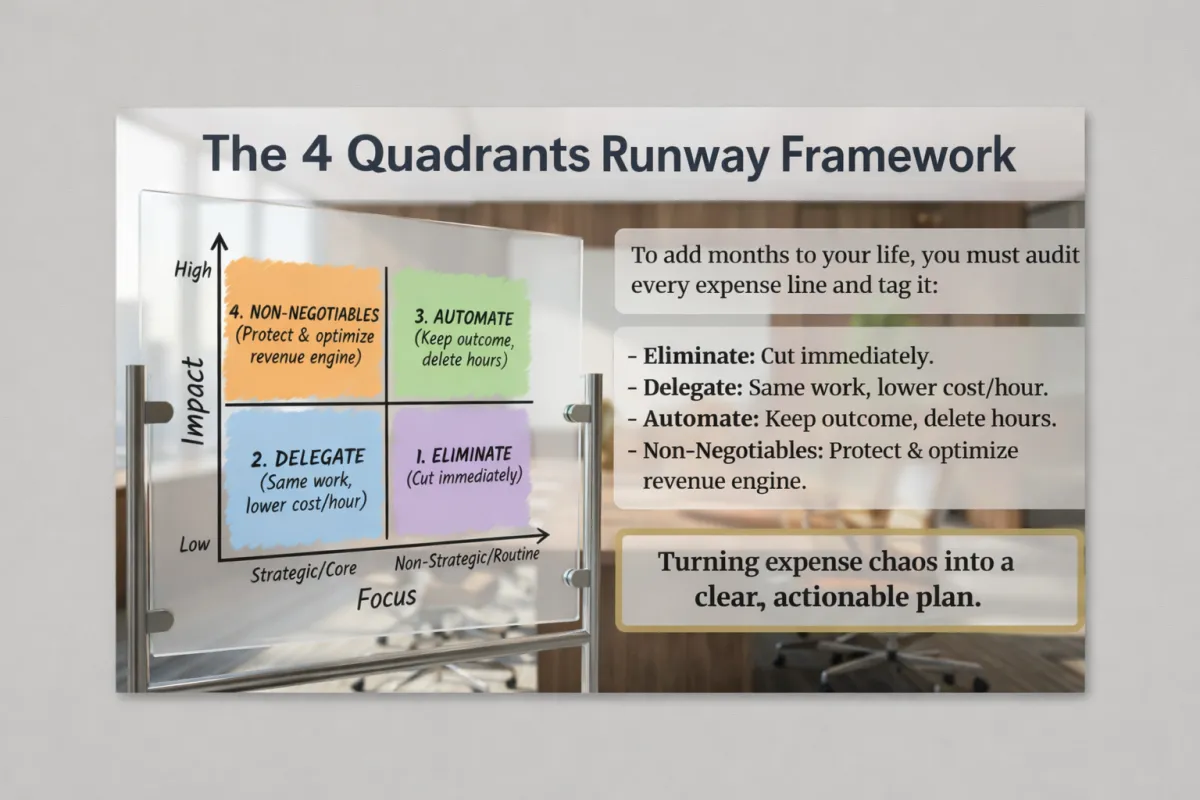
Carry out an assessment using the 4 quadrants runway framework. Think of this as your runway accelerator.
It forces you to assess every expense line and tag it: Eliminate, Delegate, Automate, or Non-Negotiable. You’re turning expense chaos into a clear, actionable plan to add months to your cash buffer.
If you don’t address your runway, the next small shock won't be a minor inconvenience, it will be an existential threat. A payroll delay, a lost client, or a slow season becomes a life-or-death crisis, forcing you into desperate, costly actions like letting go of your best people. You lose the ability to make rational decisions, panic sets in, and you risk shrinking your business to death.
You need to move from hoping to planning.
Start your 30-day runway sprint today.
Rememer it’s a process.
Week 1. Eliminate to free up quick cash (5–15% of monthly spend).
Week 2. Delegate, lower cost per hour, your assistants.
Week 3. Automate to turn non-billable time into capacity and shorten your cash collection cycle.
Recalculate your runway monthly so your team sees progress in extra months of survival, not just pounds saved. A business that sleeps well is a business that grows well.
Which expense are you going to Eliminate first?
#businesskoachingclub #Ai #AIassessment
C
